 6 hours ago
6
6 hours ago
6
To nurture a chess talent into a grandmaster, many Vietnamese families are forced to spend massive sums each year, taking on a heavy financial burden with limited support.
Dau Anh Bac, father of Vietnam's current number-three chess player Dau Khuong Duy, said his son participates in about 20 domestic and international tournaments annually. While the state officially funds participation in the Southeast Asian, Asian, and World Youth Championships, the family must self-finance the remaining international open tournaments.
"Each tournament can cost from VND50 million (US$1,900) to 100 million depending on the location and time of the competition," Bac said.
 |
|
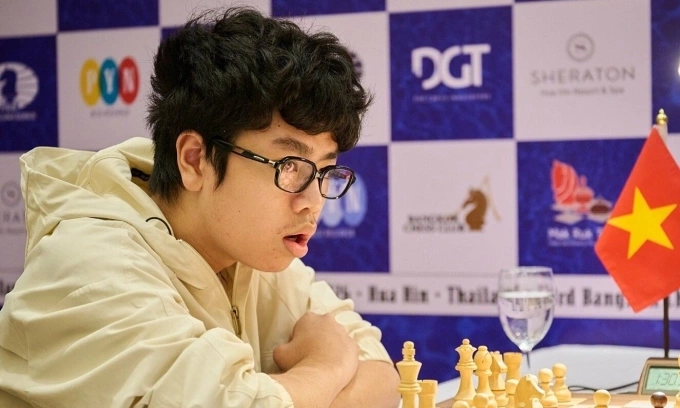
15-year-old Dau Khuong Duy during a chess match with Brandon Jacobson in the eighth round of the Bangkok Open, where he won the title, April 18, 2026. Photo by Bangkok Open |
Staggering cost
With about 10 self-funded international tournaments each year, a family's travel and competition costs can easily reach VND500 million to 1 billion. This figure does not include the costs of equipment and training sessions.
According to Bac, the most expensive expense is sending his son abroad to compete and gain experience. Before each tournament, the family had to contact organizers to request support for accommodation and meals. Most only offer partial assistance, if any.
Securing a world-class coach is another major financial hurdle. While finding a foreign coach is not difficult, their fees are well beyond the financial capability of most Vietnamese families.
"A quality international coach typically charges between $250 and $300 per hour," Bac said.
Despite the high costs, Bac's family has never considered giving up. They continuously try to balance their finances while holding onto the hope that as their son levels up, sponsors will step in.
"But so far, that hasn't happened," he noted.
Shared global struggle
These experiences reflect the reality behind the success of young chess talents in Vietnam. While achievements at international youth tournaments are widely celebrated in the media, few realize they are the result of years of investment from families.
This situation is not exclusive to Vietnam. Dr. Rajinikanth, father of Indian prodigy and eventual world champion Gukesh Dommaraju, experienced a similar journey. In his early years, Gukesh received almost no significant financial backing.
"There was absolutely no support until Gukesh became an International Master in 2018," Rajinikanth said.
 |
|
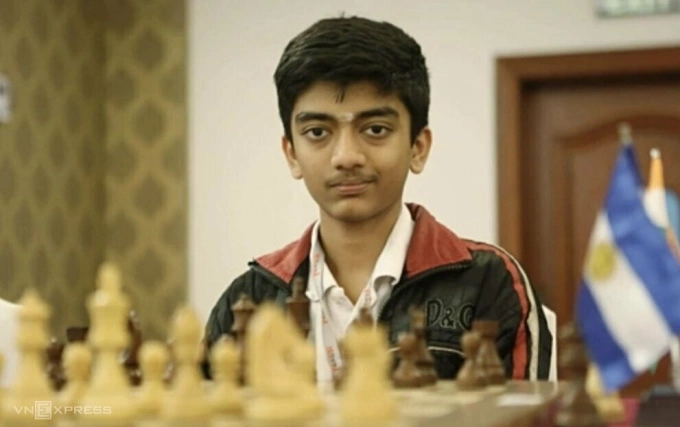
Indian Grandmaster Gulesh Dommaraju at the HDBank Open international tournament in Ho Chi Minh City in March 2019. Photo by VnExpress/Xuan Binh |
When Gukesh reached an Elo rating of around 2,300, his parents realized domestic competition was no longer sufficient. They took a massive financial risk, even borrowing money, to send him to Europe to chase international success. From mid-2017 to early 2019, Gukesh competed internationally using family funds, with annual expenses ranging from $25,000 to $30,000.
"We had to make major financial decisions and even borrowed money in a year or two to see what our son is really capable of," Rajinikanth added.
Only after achieving the International Master title did Gukesh receive his first financial support from his school and a technology company. Following his Grandmaster title, he received a one-time $10,000 bonus from the Indian government.
While Rajinikanth noted that struggling without sponsors is common in India, the South Asian nation still holds significant infrastructural advantages. India boasts a dense tournament system, elite coaches and academies like the WestBridge Anand Chess Academy, which provided Gukesh with access to top-tier coaching. Meanwhile, Vietnam currently lacks an equivalent support system.
Systemic gaps and career uncertainties
According to the World Chess Federation (FIDE), there are approximately 2,000 Grandmasters worldwide. Achieving the title grants players career benefits, including fee exemptions for open tournaments and direct invitations to closed events. The earlier a young player becomes a Grandmaster, the greater their chances of being invited to more prestigious tournaments.
Vietnam currently has 13 Grandmasters, four of whom achieved the title before the age of 20: Dao Thien Hai, Nguyen Ngoc Truong Son, Le Quang Liem, and Nguyen Anh Khoi.
However, parents of young Vietnamese players argue the biggest challenge isn't just financial. It is the lack of a clear, systemic development roadmap for talents.
 |
|
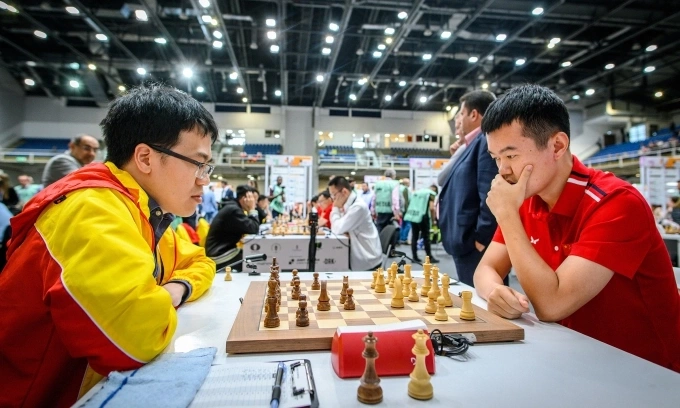
Vietnam's Le Quang Liem (L) in a game against China's Ding Liren in the sixth round of the Chess Olympiad in Budapest, Hungary, on Sept. 16, 2024. Photo by FIDE |
"Short-term achievements or the number of medals shouldn't be the sole goal," said the parent of a top-10 Vietnamese player. "What's more important is building a generation of chess players with a solid professional foundation, capable of competing in big Asian and world tournaments."
While Vietnam frequently sends large, successful contingents to rapid and blitz chess tournaments to hunt for medals, these events often lack world-class opponents. To reach the elite level, key players need investment in standard chess and access to top international tournaments and top-tier coaching, rather than relying on an approach where each family figures it out on their own.
The greatest fear for many families is long-term career viability. Many parents feared that their children would not be able to make a living from professional chess. In the past, there were former grandmasters who switched to teaching as they reached adulthood. Many young Vietnamese talents cannot succeed simply because it is too expensive.
Vietnamese chess is currently thriving at the grassroots level, with dozens of active clubs in every locality. Finding raw talent is no longer the issue. The true challenge is nurturing that talent beyond adolescence, when the race to the Grandmaster title suddenly demands massive investments.