 1 month ago
95
1 month ago
95
According to Malaysian media, the Football Association of Malaysia (FAM) should not rely on naturalizing players to surpass Vietnam in Southeast Asia.
Following Malaysia's 1-3 defeat to Vietnam in the 2027 Asian Cup qualifiers, local media continued to debate how to narrow the gap with their regional rival.
However, instead of encouraging naturalization which has been adopted in large scale by Malaysia, an article by football journalist Ajitpal Singh for the New Straits Times called for the opposite approach.
Singh called for abandoning quick shortcuts and reforming Malaysian football from its very roots.
He referred to the widespread debate on Malaysian social media following the disappointing defeat in Vietnam, where the home team came out on top, largely thanks to a brace from naturalized striker Nguyen Xuan Son.
Many fans argued that Malaysia needs to find more naturalized players to beat Vietnam. However, Singh countered this sentiment.
"After everything that's happened, Malaysian football seems to have learned all the wrong lessons. Has it gone completely off the rails?" he wrote.
Singh argued that Malaysian football continues to seek quick fixes instead of addressing fundamental systemic issues. Recent scandals, particularly the case of seven ineligible naturalized players, should have been a wake-up call.
"Yet here we are, still flirting with the same shortcut," he added.
Excluding the seven players banned by FIFA for naturalization fraud, Malaysia still had 13 foreign-born players registered for the Vietnam match. Of these, 10 were mixed players and three were fully naturalized without Malaysian ancestry.
The New Straits Times article suggested that this continued reliance on mass naturalization is baffling.
"Malaysian football should steer well clear of that mess. Instead of fixing the system, the instinct remains to import solutions. Maybe what Malaysian football really needs isn't more naturalized players but ‘naturalized’ administrators," Singh continued.
This view contrasts with other opinions in the region, especially as Vietnam successfully utilize fully naturalized players like Xuan Son and Do Hoang Hen, both Brazilian-born who were granted Vietnam's citizenship after having lived in the country for five years under FIFA regulations.
Malaysian football expert Zulhelmi Zainal Azam recently told Astro Arena that Vietnam are the strongest team in Southeast Asia because of these additions.
"We don't need more 'Latinos and Amigos', parachuted into the national setup, unable to sing Negaraku or string together a sentence in Bahasa Malaysia," Singh wrote. "What we need is identity, patience and belief in our own pipeline."
According to statistics, many national players have 25% or 50% Malaysian ancestry but cannot sing the national anthem or communicate with locals because they were raised abroad.
 |
|
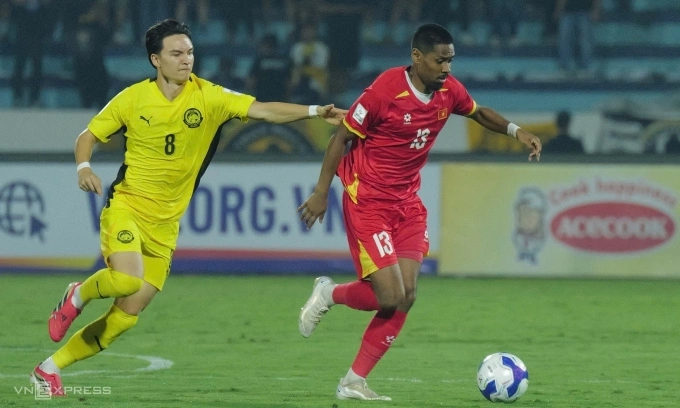
Malaysian-English midfielder Stuart Wilkin (number 8) chases after Vietnamese-French defender Cao Pendant Quang Vinh during the Asian Cup qualifiers match at Thien Truong Stadium on March 31, 2026. Photo by VnExpress/Ngoc Thanh |
To clarify his argument, the author cited Japan and South Korea as prime examples of sustainable football development. These two Asian powerhouses did not take shortcuts to reach the international stage.
Instead, they developed systematically from school and community levels all the way to professional youth academies. Japan transformed physical limitations into technical advantages, creating players who are tactically superior, fearless and well-rounded.
The article also analyzed Malaysia's National Football Development Program (NFDP). Established in 2014, it is a national youth project aiming to build a training roadmap from the grassroots to the elite level.
Despite millions of dollars invested into the program and its core Mokhtar Dahari Academy, Malaysia failed to produce world-class players.
While acknowledging the current lack of global stars, Singh insisted this is no reason for fans or officials to panic.
He noted that even top global academies like Benfica or Ajax only see a small percentage of their youth players make it to the first team, arguing that it is the nature of development and requires a long-term approach, not shortcuts.
Singh suggested that all clubs in the domestic league must seriously invest in youth development to mirror the NFDP. This would increase the player pool, strengthen competition and elevate overall footballing quality.
Currently, the domestic league is dominated by foreign, naturalized, and mixed players, which creates disruption rather than progress.
However, the article did not completely dismiss the concept of naturalization.
"Naturalization is not the villain," he wrote. "Used correctly, it can raise standards and provide healthy competition."
To conclude the article, Singh warned that the Malaysia national team are at risk of becoming entirely dependent on imported talent to remain competitive. Malaysia still have to call up domestic players who didn’t get enough playing time at their clubs and put the expectations on them.
Both Malaysia and Vietnam are preparing for the upcoming 2026 ASEAN Cup, scheduled for July 24 to Aug. 26.