 1 month ago
70
1 month ago
70
Marathon tracking teams, known as "Strava Police," have recently sparked controversy for exposing runners who tattoo race times that do not match their official results.
Tattooing a marathon finish time is a popular way to honor an achievement after a race. However, tensions are rising as some runners are being called out for tattooing results that are faster than their actual times.
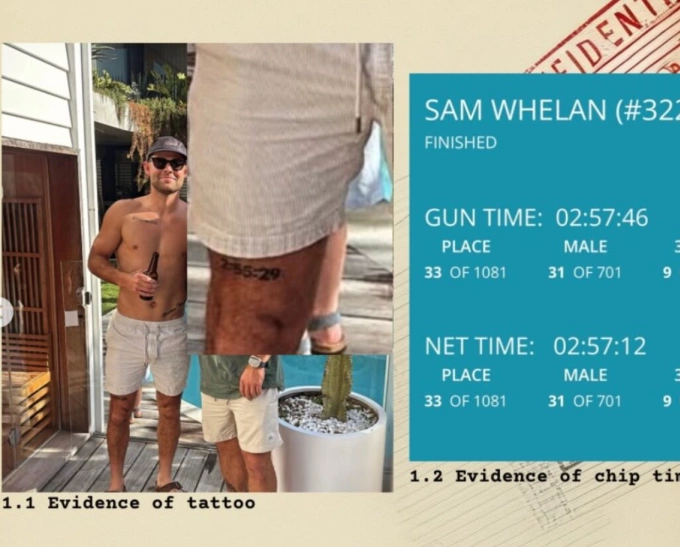
A group called the Official Marathon Time Integrity Unit (OMTIU) has been at the forefront of this movement. By cross-referencing race data, GPS activity, and social media posts, the group recently highlighted several cases where tattooed numbers were significantly faster than official results.
The OMTIU specifically targets the growing trend of fitness influencers who prioritize GPS data over official race results. In 2025, the group launched an Instagram account, @officialunofficialtime, which has quickly amassed over 30,000 followers.
 |
|
The Official Marathon Time Integrity Unit (OMTIU) exposes a runner who got a tattoo claiming faster marathon time than their actual performance. Photo by OMTIU |
According to the group’s investigations, some runners choose to tattoo a time based on when their watch hit the 42.195 km mark, rather than when they actually crossed the finish line. Others use moving time, a metric that pauses during stops for water or restrooms, instead of the elapsed time in the competition.
Besides the cases exposed by OMTIU, the international running community has witnessed similar controversies where runners use data from Strava or GPS watches to announce their times instead of official results.
This issue occurred at major races like the Boston Marathon, where many runners shared "sub-3" times based on the time their watches reached 42.195 km, while the official chip time was a few minutes slower due to the actual distance being longer than the standard measurement. This led to heated debates on forums like Reddit and LetsRun, with some arguing that personal best (PB) should be based on official results, not Strava.
Similar situations also happened at the London Marathon, where many runners posted photos of their Garmin or Strava watches with results that looked better than the actual times.
The OMTIU's aggressive approach of publicly naming and shaming runners has faced mixed reactions. Critics argue that public humiliation over a few minutes of difference is extreme, while the group maintains their mission is to protect the integrity and precision of the sport, arguing that in a marathon, any form of displaying results, especially permanent ones like tattoos, needs to be accurate.
In races, chip times are used instead of gun times because of their higher accuracy. While the course is professionally measured, GPS can be inaccurate, causing the clock to hit 42.198 km before the finish line.
According to Canadian Running Magazine, many runners have encountered GPS errors, and not everyone checks thoroughly before publishing their results. Therefore, even though the discrepancies in these cases are clear, many argue that publicly investigating a difference of just a few minutes may be unnecessary, even extreme.