 1 month ago
96
1 month ago
96
By Hoang An  April 13, 2026 | 10:37 pm PT
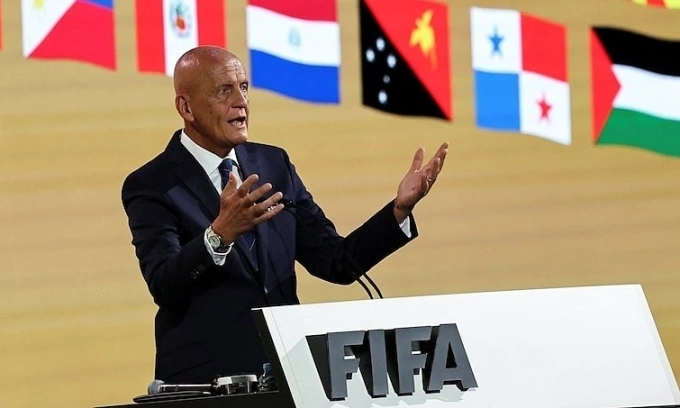
Chairman of the FIFA Referees Committee Pierluigi Collina speaks at the 74th FIFA Congress at the Queen Sirikit National Convention Center in Bangkok, Thailand, on May 17, 2024. Photo by Reuters
In the list of referees who will officiate at the 2026 World Cup, Southeast Asia has no representatives, a step backward compared to the previous tournament.
On April 9, FIFA unveiled the list of 170 officials, comprising 52 referees, 88 assistant referees and 30 Video Assistant Referees (VAR). The Asian Football Confederation (AFC) secured 25 spots on the list, including eight head referees from Australia, China, Japan, Jordan, Qatar, Saudi Arabia, the UAE and Uzbekistan.
Southeast Asia and South Asia were the only regions within the AFC to be entirely excluded.
This absence marks a decline in regional standing compared to the 2022 World Cup in Qatar, where Singapore's Muhammad Taqi served as a VAR. Taqi was the fifth Singaporean official to reach the world stage, following George Suppiah (1974), K. Visvanathan (2002), Shamsul Maidin (2006), and Jeffrey Goh (2010).
Aside from Taqi’s inclusion in 2022, Southeast Asia has failed to send a referee to the tournament since 2010.
The exclusion has sparked disappointment across regional media. In Malaysia, there was high hope for Nazmi Nasaruddin, who had been shortlisted as a candidate and attended several FIFA training seminars but was ultimately cut, according to New Straits Times.
Malaysia has not seen an official at the World Cup since Subkhiddin Salleh in 2010.
Similarly, Thailand's sports outlets expressed regret over the omission of Sivakorn Pu-udom. Despite being a regular face in AFC tournaments, he failed to make the final list, Thairath reported.
Thailand's referee at a World Cup was assistant referee Prachya Permpanich in 2006.
Vietnam continues the wait for their first-ever World Cup officiating debut.
Pierluigi Collina, chairman of the FIFA Referees Committee, said that the selection was the result of a three-year evaluation process. Officials were monitored and trained through conferences and their performances in both domestic leagues and international tournaments managed by FIFA.
The 2026 World Cup will be the biggest in history, with 48 teams and 104 matches, a significant increase from the 32 teams and 64 matches in the 2022 World Cup. The referee list this time also includes six women, continuing the trend adopted from the previous tournament in Qatar.